
AI Doesn't Save Money. It Moves It.
The companies winning with AI aren't the ones cutting costs. They're the ones earning faster.

There's a contradiction sitting in the middle of most AI workforce strategies right now. It's being talked about — in board rooms, in HR leadership forums, in analyst reports. And yet it keeps getting acted on incorrectly.
On one side of the table: the CFO presenting headcount reductions justified by AI productivity gains. On the other: the CIO submitting an emergency budget request because the engineering team burned through the entire year's AI spend in four months.
Both things are happening. At the same company. Sometimes in the same quarter.
The Observations
Uber deployed Claude Code to its engineering team in December 2025. By March, 84% of engineers had adopted it. By April, the full-year AI budget was gone. Per-engineer monthly costs ran $150–$250 on average — up to $2,000 for the heaviest users. The COO's conclusion: "It's very hard to draw a line between one of those stats and 'Okay, now we're actually producing 25% more useful consumer features.'"
Microsoft — which invested $13 billion building Copilot — watched its own internal teams adopt a competitor's tool instead. When engineers inside the Experiences & Devices group were given access to Claude Code, they used it so heavily that Microsoft eventually cancelled the licenses. Not because the tool failed. Because the engineers embraced it too well.
These are extreme examples from companies running advanced, token-heavy AI workloads. Most enterprises — hospitality, manufacturing, financial services, retail — aren't burning through tokens at this rate. If your organization runs on Microsoft 365 Copilot or similar seat-licensed tools, your cost structure looks different. More predictable. More controllable.
But the underlying dynamic still applies. And a structural shift in how AI is priced is about to make it more visible everywhere.
The pricing model is changing. For years, enterprise AI tools were sold as flat-fee SaaS: pay per seat, unlimited use. That model is ending. Anthropic shifted its enterprise plans to usage-based billing in November 2025. OpenAI updated its Codex pricing to token-based in April 2026. GitHub is moving all Copilot plans to AI Credits starting June 2026. The direction of travel is clear: the more you use, the more you pay — and advanced models will always cost more than the ones you can afford to commoditize.
Meanwhile, at the macro level:
- 95% of enterprise AI pilot programs fail to deliver measurable financial returns (MIT, 2025)
- Only 6% of organizations qualify as genuine AI high performers — defined as achieving 5%+ EBIT impact (McKinsey, 2025)
- Companies that laid off workers citing AI automation show no statistically significant difference in ROI compared to companies that didn't (Gartner, 2026)
The layoffs happened. The savings didn't follow.

The Insight: You Can't Win a Race by Cutting Fuel
Here is the question most organizations are trying to answer: If we reduce workforce and invest in AI tools, will our operations become cheaper?
It sounds like the right question. It isn't.
The problem is that the math can't close — not durably. You cannot calculate how many headcount reductions will fund your AI investment, because the tool landscape evolves faster than any budget cycle. The cost of the most capable models is not going to fall to zero. If you use the advanced models, you pay a premium. If you don't use the advanced models, you fall behind competitively. There is no middle path that is both cheap and effective.
This is a structural feature of the market, not a temporary condition. What economists call Jevons Paradox makes it worse: as AI tools become more capable and efficient, usage expands to fill the new capacity. More output means more tokens. More tokens means more cost. The productivity gain and the cost increase are the same event.
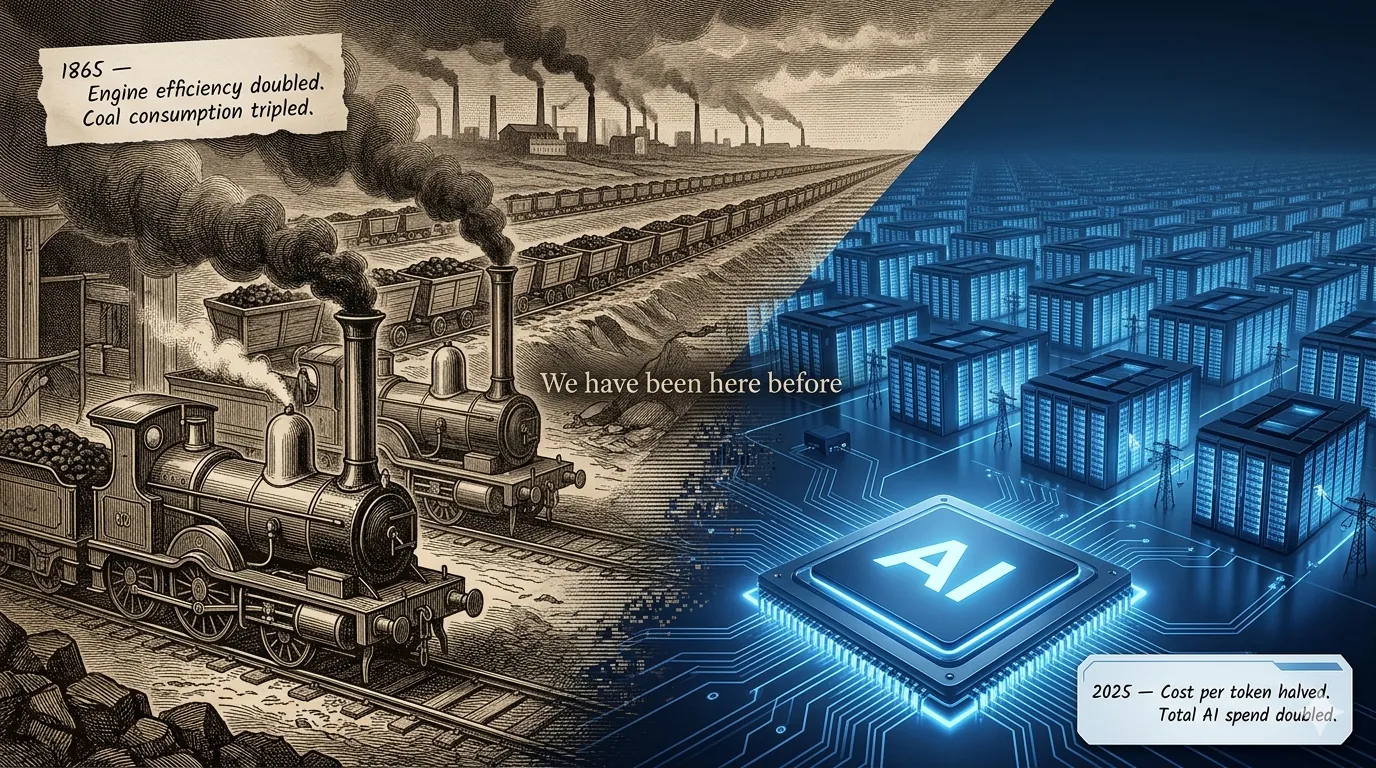
The money doesn't disappear. It migrates — from the HR department's payroll line to the IT department's compute line. The org chart gets flatter. The vendor invoice gets larger. The total cost of getting work done stays roughly constant. It just reports to a different VP.
Here's the sharper version: Saving money on your balance sheet will not help you win the competition. Earning money 2x faster than you spend it will — and that is entirely achievable with AI deployed well.
The companies pulling ahead aren't the ones who cut the deepest. They're the ones who moved the fastest: adapted their ways of working, upskilled their people, and used AI to accelerate value creation — more output, better decisions, faster time-to-market. Cost optimization is a byproduct of that, not the goal.
What This Means at the Board Level
Most AI workforce strategies have been framed as cost-reduction plays. The narrative is clean: AI increases output per employee, therefore you need fewer employees, therefore headcount costs fall. The savings fund the AI investment.
The data does not support this narrative. What is actually happening is cost substitution, not cost reduction.
Three things are typically missing from the business case:
1. Induced demand is not modeled. When employees have access to capable AI tools, usage expands beyond the original scope — especially as pricing shifts to consumption-based models. Budgets approved for one year of flat-fee access may not hold when renewal terms change.
2. The productivity-to-value translation is unmeasured. Speed of output is not the same as value of output. Uber's own leadership acknowledged they could not draw a straight line between token consumption and useful features delivered to customers. Faster ≠ better. More throughput ≠ more revenue.
3. Workforce capability risk is unpriced. When experienced employees exit, the institutional knowledge, judgment, and relationship capital they hold doesn't transfer to the model. It evaporates. That cost doesn't appear on any balance sheet until a critical decision fails or a key client relationship breaks.
Recommendations for CHROs and Business Leaders
1. Reframe the board conversation: cost visibility, not cost reduction. Before approving any AI-driven workforce restructuring, require a full cost migration analysis. Where are the dollars going? Payroll to compute is a transfer, not a saving. Present the total cost of work delivered — not just headcount cost — and track it over time.
2. Make AI governance a workforce planning function. As pricing shifts to usage-based models, AI tool spend starts to behave like labor cost: variable, difficult to predict, directly tied to output. CHROs should own a seat at the AI spend governance table, not just IT.
3. Invest in value creation capacity, not just efficiency. The organizations winning with AI are not the ones who cut the most. They are the ones who used AI to do things they could not do before — serve customers faster, enter markets quicker, generate insights that were previously inaccessible. Redesign roles around value creation. Train for judgment, not just tool use.
4. Separate speed of adoption from quality of adoption. Rolling out AI tools broadly is not the same as using AI effectively. Sustained value comes from employees who understand how to direct AI output toward business outcomes — a skill that takes deliberate development. The companies that skip this step get throughput without impact.
5. Set a "cost-to-earn" ratio, not just a cost target. If AI helps your team generate $10 in revenue or customer value for every $3 spent on tools and compute, that is a compelling business. If it moves $3 from payroll to compute and generates the same $10 you were generating before, you have bought yourself a flat result at significant disruption cost. Know which one you're building.
The Strategic Imperative
A useful question to bring to the next board conversation:
We have a line on the P&L that says we saved $X by reducing headcount. Do we have a corresponding line that tracks where those dollars resurfaced — and a line that shows how much faster we're generating revenue as a result? If not, we don't have a transformation story. We have an accounting migration with a press release.
AI is not a cost-cutting strategy. It is a capability-shifting, value-accelerating strategy. Used well, it expands what your organization can do and how fast it can do it. Used naively, it transfers your payroll budget to AI vendors while simultaneously degrading the institutional knowledge that makes your organization distinctive.
The bowl gets cleaned faster. But if you're not selling more dishes, the water bill is just a new cost.
The race is not about who spends less. It's about who earns more.
One More Thing — Coming Next
There's a dimension this post hasn't touched, and it may be the most important one.
We've talked about whether the money math works. But before the money question comes a people question: do your employees actually know how to use these tools well?
Organizations are buying AI licenses, provisioning access, and declaring transformation. But are they evaluating whether their people are ready? Are managers equipped to direct AI-augmented work? If we start treating AI as a member of the workforce — and in many ways, it already is — then the question sounds familiar: if you hire a high-potential employee into your organization, how do you know the manager is the right person to lead them? How do you ensure that person is able to fully contribute, and go beyond?
HR has been asking this question about human talent for decades. We haven't started asking it about AI-human teams yet. We should.

That's the conversation for next time.
How is your organization measuring the real return on AI investment — not just cost savings, but value created? I'd like to hear from CHROs and business leaders who are navigating this.
Sources
- Uber Spends Full 2026 AI Budget in 4 Months
- Uber COO: AI spending hard to justify
- Microsoft and Uber Report AI Cost Overruns
- Josh Bersin: AI Prices Are Going Up
- AI-driven layoffs aren't making business sense
- AI Layoffs 2026: The ROI Reality Check
- Microsoft Copilot Adoption Challenges
Ian Xie
June 4, 2026
ian.us.ci