
The Human in the Loop Is Not the Safety Net You Think It Is
The research literature has been quietly dismantling the human-in-the-loop assumption for two years. The industry is now saying it out loud. HR hasn't yet answered the accountabili…

The standard answer to AI accountability in HR is: keep a human in the loop.
Put a manager in the chain. Have HR review the recommendations. Make sure a person signs off before the system acts. Most enterprise AI governance frameworks say some version of this. It sounds right. It feels responsible.
The research literature has been quietly dismantling this assumption for two years. The industry is now saying it out loud. And HR hasn't yet answered the accountability question this creates.
What the Research Actually Shows
A 2024 study from ETH Zurich and the Max Planck Institute — published via Oxford Law Blogs — ran a controlled experiment on automated decision support systems. The findings were uncomfortable: human oversight increased how much people trusted and used AI recommendations. It decreased the accuracy of final decisions. When the humans in the loop did push back on the AI's output, they made smaller corrections — not larger ones — when the errors were biggest. Rather than serving as an emergency brake, human monitors tended to defer most precisely when they should have intervened.
The researchers framed this as a design problem, not a people problem. The issue wasn't that the humans were careless. It was that the system wasn't built to make meaningful pushback easy, expected, or rewarded.
That finding didn't sit in isolation. In May 2025, a peer-reviewed editorial in Frontiers in Political Science — from researchers at Delft University of Technology and the Vienna University of Economics — synthesized a body of work on human participation in automated decision-making and reached a pointed conclusion: effective HITL requires human input to be meaningful, not just "rubber-stamping decisions from automated systems." The authors called on the field to move beyond simplistic human approval models toward frameworks where humans and AI genuinely complement each other's strengths.
By January 2026, the framing had shifted further. A guest column in SiliconANGLE by the co-founder of Holistic AI declared plainly: "Human-in-the-loop has hit the wall." At the scale and speed AI now operates — in fraud detection, logistics, agentic workflows — the idea that humans can meaningfully supervise AI decisions one at a time is, in his words, "a comforting fiction."
That argument is about enterprise AI at scale and velocity. But the underlying logic applies directly to HR. And in HR, the stakes are not transaction errors or logistics delays. They are people's careers, development trajectories, and working lives.
Now Translate This into an Enterprise HR Context
The manager who receives an AI-generated flight risk alert is the human in the loop. The research predicts, with reasonable confidence, what happens next: the manager is more likely to act on the recommendation than they would be on their own instinct. They are less likely to challenge it. And when the model is most wrong — when the flag is least deserved — they are least likely to correct it.
This isn't a criticism of managers. It's a description of how humans interact with algorithmic authority. The model carries an implicit credibility that individual judgment struggles to override, especially under time pressure and information asymmetry.
What Gets Lost When the Loop Fails
The manager in this scenario is not just an accountability checkpoint. They are the person with the operational knowledge the model doesn't have: the day-to-day context of the individual being flagged, the circumstances the training data never captured, the pattern that only makes sense if you were in that team meeting last quarter.
When managers defer to the model rather than contributing what they know, the human in the loop becomes a rubber stamp with a name attached. Accountability appears to exist. The substance of it has been hollowed out.
This is the actual accountability gap. Not the absence of a human in the chain — most organizations have that — but the absence of conditions that make meaningful human judgment possible at the point of decision.
A More Honest Accountability Map
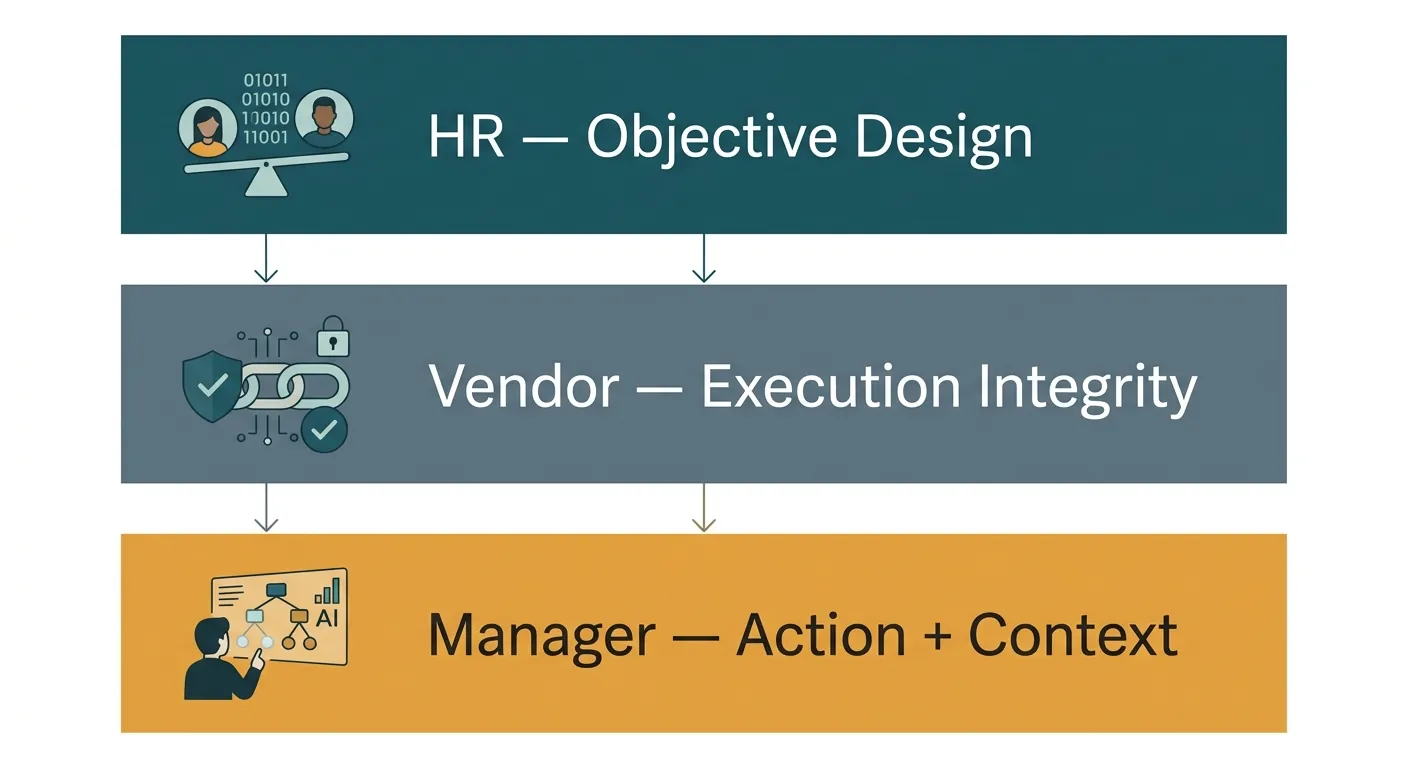
Keeping a human in the loop is necessary but not sufficient. What's needed alongside it is clarity about who owns which failure mode — because the failure modes are different:
HR owns the objective design — what the model was asked to optimize for, whether that proxy was appropriate, and whether the deployment decision was sound. If the model was built to optimize for the wrong thing, that's HR's accountability.
The vendor (or internal IT team, where tools are built in-house) owns execution integrity — whether the model ran as designed, whether edge cases were handled, whether the logic remained stable over time. This is not something HR can own without visibility into the system's internals.
The manager owns both the action and the operational contribution — not just signing off on a recommendation, but actively bringing the contextual knowledge the model lacks. That requires the system to be designed to make that contribution possible: what information managers are shown, what it takes to override a flag, whether pushback is structurally easy or structurally hard.
What Closing the Gap Actually Looks Like
The accountability map matters, but only if it changes behavior at the point of decision. Three things make it real.
First, failure modes need named owners before deployment — not after an incident. HR owns the objective. The vendor owns the logic. The manager owns the action and the operational context. That mapping should exist in writing before the system goes live.
Second, the system needs to be designed to make meaningful manager input structurally easy. Not a checkbox override. A visible prompt: what do you know about this person that the model doesn't? That question alone changes the dynamic.
Third, HR should treat manager pushback as a data source, not an inconvenience. The cases where managers override AI flags are the most valuable feedback the system can receive. If that signal isn't being captured and fed back, the model never improves and the loop never closes.
Human oversight isn't the problem. Human oversight that isn't designed to work is. The fix is within reach — it just requires treating governance as a design decision, not a compliance checkbox.
Sources
- Sele & Chugunova, "Putting a Human in the Loop" (2022), Oxford Law Blogs
- Wagner, Kuebler & Zalnieriute, Frontiers in Political Science (May 2025)
- Emre Kazim, "Human-in-the-loop has hit the wall", SiliconANGLE (January 2026)
Ian Xie
June 2, 2026
ian.us.ci